

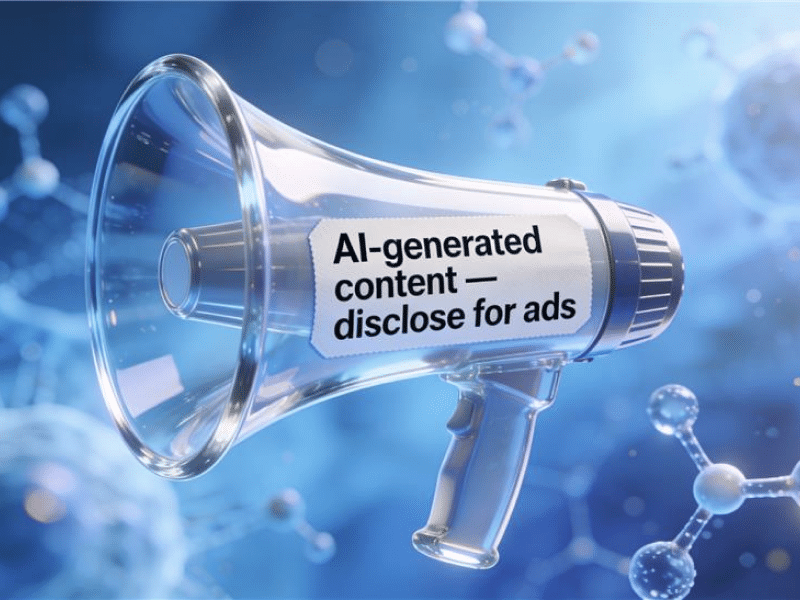
En February 4, 2026, el German Competition Authority published new guidance clarifying how AI-generated advertising content must be labeled under the EU Artificial Intelligence Act (Regulation (EU) 2024/1689) and German unfair competition law. Issued by the Central Office for Combating Unfair Competition Frankfurt am Main e.V. (Wettbewerbszentrale), the guidance applies to businesses using AI in commercial communications. The relevant transparency obligations will apply from August 2, 2026.
Detalles de la actualización
The guidance explains how Article 50 of the EU AI Act applies to advertising and marketing use cases, focusing on transparency obligations for deepfakes, AI-generated texts, chatbots, y AI avatars. It clarifies when labeling is required, particularly where AI-generated content resembles real persons, objects, or events and may appear authentic.
The document also clarifies the distinction between “providers” and “operators”, confirming that businesses using AI systems for commercial purposes qualify as operators and are responsible for compliance unless the use is purely personal and non-professional.
In addition, the guidance addresses risks of “AI washing,” emphasizing that marketing products or services as AI-based without substantive AI functionality may constitute misleading commercial practices bajo el German Act Against Unfair Competition (UWG).
Transparency Obligations Under Article 50
AI-generated or manipulated image, audio, or video content that resembles real persons, objects, or events and may appear authentic must be clearly labeled bajo Article 50(4) of the EU AI Act.
Para AI-generated texts published in the public interest, disclosure may be required unless the content has undergone meaningful human review or editorial control.
When deploying chatbots or AI avatars, users must be informed at the start of the interaction that they are communicating with an AI system, and machine-readable labeling is required.
Enforcement Exposure
Non-compliance with the transparency obligations may result in administrative fines under the EU AI Act y civil claims from competitors or associations under German unfair competition law.
Fecha de entrada en vigor
The relevant transparency and labeling obligations under the EU Artificial Intelligence Act discussed in this guidance will apply from August 2, 2026.
Por qué es importante
This update provides regulatory clarity on mandatory transparency and labeling obligations for AI-generated advertising content, supporting alignment with EU digital governance while minimizing unnecessary compliance burden. It reinforces expectations around truthful AI-related claims and reduces legal and reputational risk.
Para quién es relevante
This guidance is relevant for legal and compliance teams, marketing and communications, digital and IT functions, y AI governance teams involved in advertising, customer engagement, and public-facing content.
Próximos pasos
Organizations should review current and planned uses of generative AI in advertising, customer interfaces, and public communications to identify where labeling or disclosure is required. Legal, compliance, marketing, and digital teams should assess AI-related marketing claims and chatbot disclosures to ensure readiness ahead of the August 2, 2026 applicability date.
As organizations operationalize these requirements, RegASK supports compliance teams by translating evolving AI transparency rules into actionable insights. RegASK is a leading agentic AI regulatory intelligence and workflow orchestration platform that empowers global organizations in highly regulated sectors, including consumer products and life sciences, to proactively navigate complex regulatory landscapes. By combining advanced agentic AI with experts in the loop, RegASK delivers timely predictive actionable insights and end-to-end automation across more than 160 countries. Más información o Reserve una demostración ahora.
Preguntas frecuentes
What triggers labeling obligations for AI-generated advertising under the EU AI Act?
Labeling is required when AI-generated or manipulated content, such as images, audio, or video, resembles real persons, objects, or events and may appear authentic.
Who is responsible for compliance when AI is used in advertising?
Businesses using AI systems for commercial purposes qualify as operators and are responsible for compliance under the EU AI Act.
When do the transparency obligations discussed in the guidance apply?
The relevant provisions will apply from August 2, 2026.
How can RegASK help organizations prepare for AI advertising transparency requirements?
RegASK helps teams track AI-related regulatory updates, assess applicability across jurisdictions, and operationalize disclosure and labeling requirements through AI-driven regulatory intelligence and workflows.
Suscríbete a las últimas novedades regulatorias

Boletines informativos seleccionados
Información relevante de la industria
Acceda a información de expertos