


La IA agente está transformando la forma en que las organizaciones gestionan la inteligencia regulatoria, los flujos de trabajo de cumplimiento y la toma de decisiones. Según Tendencias tecnológicas de Gartner para 2025, La IA Agentic es la Tecnología emergente #1, que se espera ayude a las organizaciones a tomar decisiones más rápidas con mayor autonomía y eficiencia.
Sin embargo, muchos equipos aún confunden la IA tradicional con la IA agenética. Mientras que la IA clásica genera resultados solo cuando se le solicita, La IA agente está orientada a objetivos: Planifica, razona y actúa con mínima supervisión. En industrias reguladas donde las regulaciones globales cambian rápidamente, esta distinción es crucial.
Una encuesta reciente de KPMG descubrió que 1 de cada 3 organizaciones ya han escalado Agentic AI más allá de los pilotos [2], Sin embargo, la mayoría de los equipos de asuntos regulatorios aún dependen de la monitorización manual, la fragmentación de datos, sistemas aislados y ciclos de respuesta lentos. Esto se traduce en actualizaciones omitidas, retrasos en la entrada al mercado, mayor riesgo y mayores costos.
La IA agente aborda estos desafíos combinando inteligencia regulatoria, orquestación multiagente, y automatización proactiva del cumplimiento.
Esta guía explica cómo la IA de Agentic transforma el cumplimiento normativo y la inteligencia regulatoria. También descubre cómo los sistemas de Agentic automatizan la monitorización y activan flujos de trabajo, lo que ayuda a los equipos a anticiparse a los cambios regulatorios globales.
Conclusiones clave
- La IA agente es un sistema orientado a objetivos que puede planificar, razonar y actuar con supervisión humana, adaptándose a nuevos datos y cambios contexto.
- Fortalece el cumplimiento mediante Monitoreo continuo de las regulaciones globales, proporcionando evaluación de impacto, asignando actualizaciones a tareas y activando flujos de trabajo.
- Redefine los procesos de cumplimiento desde fragmentados, manual y reactivo procesos a modelos de cumplimiento proactivos y automatizados.
- Reduce riesgo, aumenta eficiencia, y admite una toma de decisiones más rápida en sectores verticales específicos.
Tabla de contenido
- Entendiendo la IA Agentic
- Por qué la IA Agentic es importante para el cumplimiento normativo
- Beneficios clave para los equipos de asuntos regulatorios
- Casos de uso reales en diferentes industrias
- Consideraciones operativas
Entendiendo la IA Agentic: Un sistema orientado a objetivos
La IA agentica es un tipo de IA avanzada que puede planificar, razonar y actuar Con mínima supervisión. A diferencia de los modelos de IA tradicionales, que solo siguen instrucciones preestablecidas (indicaciones) y se detienen, la IA Agentic:
- Trabaja hacia objetivos definidos,
- Divide tareas complejas en pasos más pequeños,
- Adapta su enfoque a medida que cambian las condiciones,
- Inicia acciones en los sistemas conectados y
- Aprende de los resultados de sus acciones [3].
Una analogía sencilla
Imagina planificar tus vacaciones manualmente: buscar vuelos, comparar hoteles, seleccionar opciones de turismo y planificar el transporte. Ahora imagina un equipo de agentes de viajes expertos coordinando todas las tareas y presentando un itinerario listo para aprobar. Ese equipo de agentes es Agentic AI.
Cómo se aplica esto al cumplimiento normativo
La IA agente funciona de manera similar para cumplimiento normativo. Utiliza múltiples agentes de IA especializados, cada uno centrado en una tarea específica, como:
- Monitoreo de cambios regulatorios
- Actualizaciones de curación
- Mapeo de cambios en flujos de trabajo internos
- Redacción de resúmenes, boletines o informes
- Activación de acciones para la aprobación humana en el circuito.
Estos agentes operan en tiempo real y están orquestados por un sistema central que garantiza que cada acción se alinee con el resultado esperado.
Como solemos resumir en RegASK:
“La IA generativa te ayuda a ver qué está cambiando. La IA agencial te ayuda a actuar en consecuencia.”
Ésta es la diferencia entre inteligencia y ejecución.
Por qué la IA Agentic es importante para el cumplimiento normativo
Los entornos regulatorios globales son cada vez más complejos, con actualizaciones frecuentes en todas las jurisdicciones. Garantizar el cumplimiento normativo en entornos multijurisdiccionales es un desafío enorme, y los procesos manuales no pueden seguir el ritmo. Los equipos suelen tener dificultades para mantenerse al día con las regulaciones cambiantes, lo que provoca retrasos en el lanzamiento de productos o riesgos de incumplimiento.
Agentic AI mejora el cumplimiento al aprovechar tres capacidades críticas:
- Identificación de tendencias regulatorias y riesgos emergentes a través del escaneo de Horizon y señales de alerta temprana para el cumplimiento proactivo
- Monitorear continuamente las regulaciones globales para Asegúrese de que ninguna actualización pase desapercibida.
- Activación de la orquestación automatizada del flujo de trabajo:Cuando se detecta un cambio regulatorio, los agentes de IA pueden:
- Actualizaciones de mapas de productos o procesos afectados,
- Enrutar tareas a los equipos relevantes,
- Generar documentación de cumplimiento y
- Preparar recomendaciones para su aprobación.
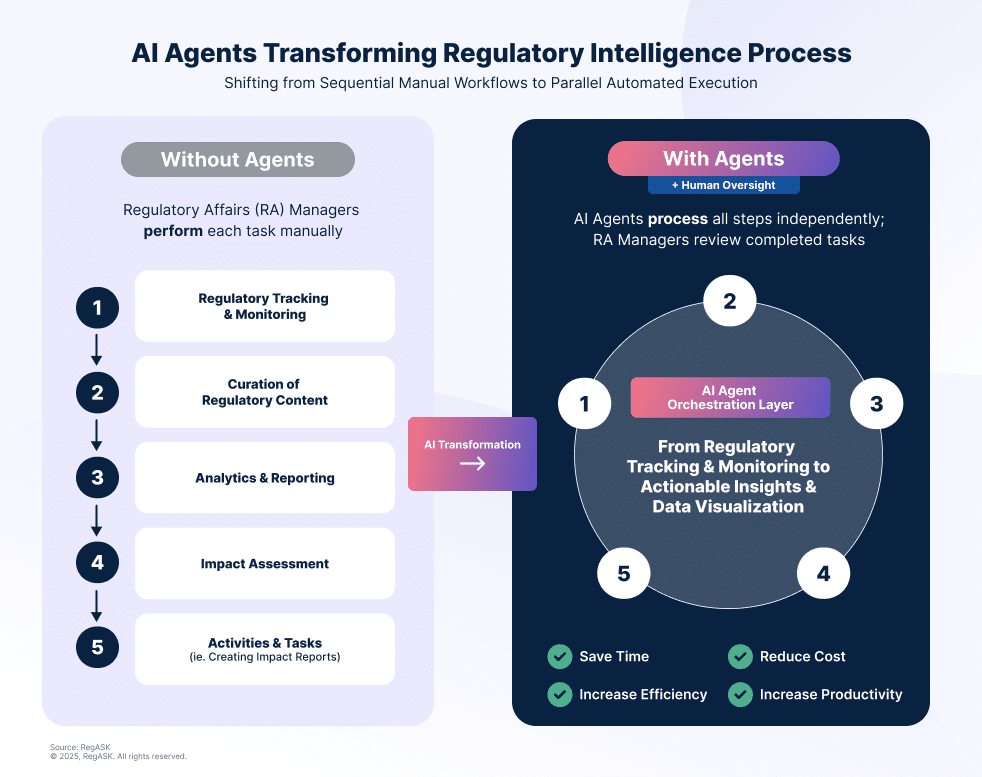
Cumplimiento manual vs. cumplimiento con IA agenética
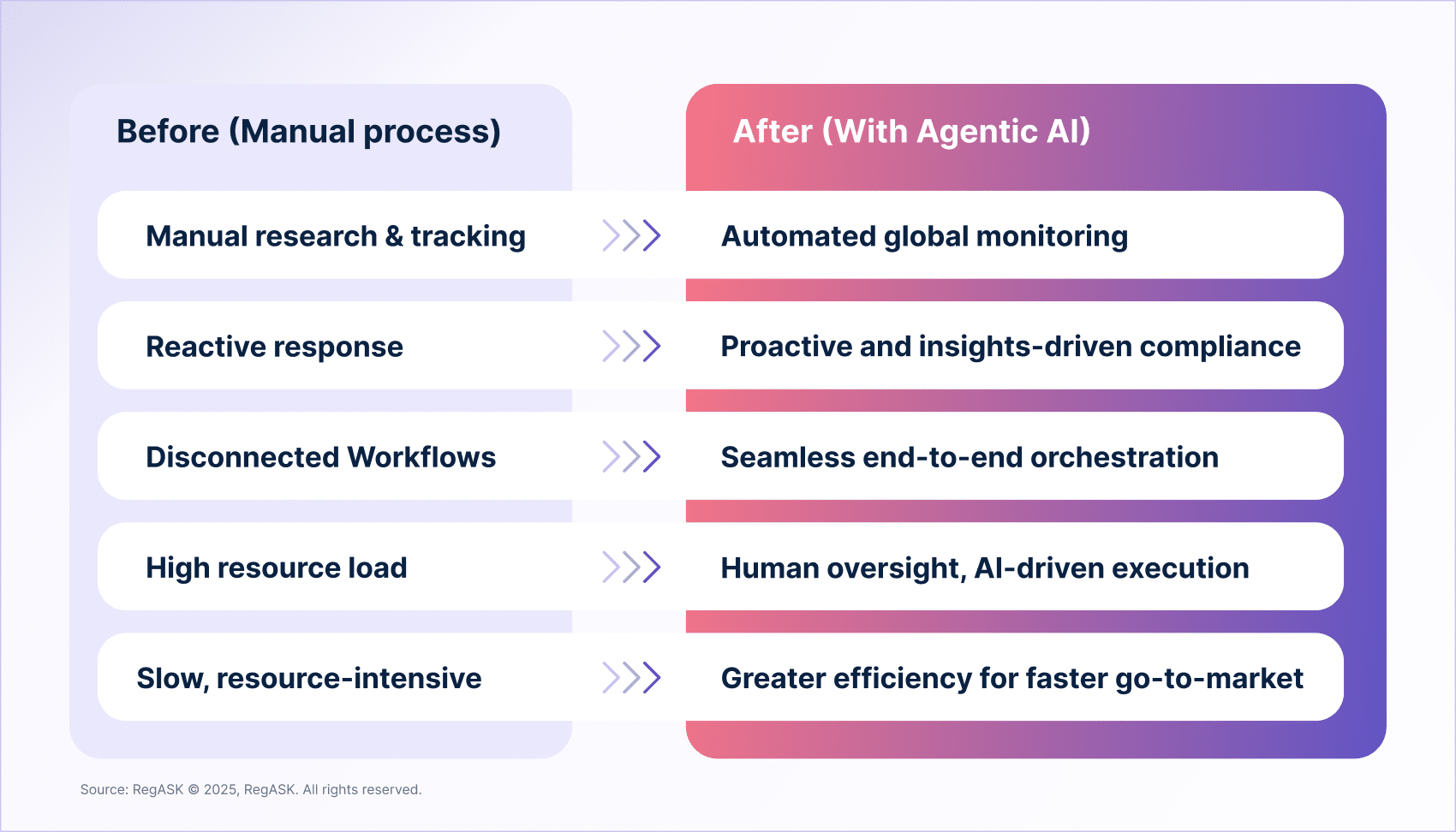
Como señala Forbes, Agentic AI equipa a las organizaciones para mantenerse resilientes frente a la complejidad regulatoria y los cambiantes panoramas de políticas al hacer que el cumplimiento sea proactivo, continuo y escalable.[4]. Esto marca un claro cambio desde procesos reactivos hacia un modelo de cumplimiento preparado para el futuro.
Beneficios clave para los equipos de asuntos regulatorios
Cuando se integra con la inteligencia regulatoria y los flujos de trabajo de cumplimiento, Agentic AI proporciona ganancias operativas sustanciales.
- Ahorro de tiempo – La automatización de tareas rutinarias (monitoreo, triaje, informes) libera a los equipos para el trabajo estratégico.
- Mayor precisión – Los agentes filtran el ruido y reducen los falsos positivos, mejorando la calidad de los datos.
- Tiempo de respuesta más rápido – La orquestación del flujo de trabajo vincula las actualizaciones regulatorias directamente con los próximos pasos.
- Recursos optimizados – Los equipos humanos se centran en la interpretación, la evaluación de riesgos y la alineación de estrategias en lugar de la recopilación de datos y las tareas manuales.
En conjunto, estos beneficios acortan el ciclo de cumplimiento, reducen el riesgo de incumplimiento y mejoran la confiabilidad general y la eficiencia operativa. La integración de Agentic AI permite a las organizaciones realizar la transición hacia Modelos de cumplimiento inteligentes de próxima generación.
Casos de uso reales en diferentes industrias
La IA Agentic se está volviendo cada vez más esencial en sectores regulados, como el farmacéutico y biotecnológico, el de alimentos y bebidas, y el de productos de salud para el consumidor. A continuación, se presentan algunos casos prácticos donde se puede aprovechar la IA Agentic:
Industria farmacéutica
- Creación de actualizaciones automáticas cuando cambian las regulaciones
- Redacción de resúmenes de alta calidad para enmiendas de prueba
- Adaptación de la documentación interna para alinearse con las directrices cambiantes
Dispositivos médicos
- Cartografía FDA o EMA actualizaciones de los controles de diseño o procesos del SGC
- Señalar brechas para mitigar el riesgo de auditoría o inspección y recomendar actualizaciones.
Alimentos y bebidas
- Seguimiento de restricciones de ingredientes o requisitos de etiquetado en los distintos mercados
- Activar acciones y recomendar actualizaciones sobre el etiquetado o los documentos
- Entrega de evaluaciones de impacto y riesgo asistidas por IA
Salud del consumidor y cuidado personal
- Monitoreo de regulaciones de reclamaciones por mercado y recomendación de textos que cumplan con las normas
- Identificación de la exposición al riesgo antes del lanzamiento del producto
En todos los sectores, Agentic AI funciona como un asistente digital, mejorando –no reemplazando– a los profesionales regulatorios.
Consideraciones operativas
Una implementación exitosa de IA Agentic no consiste en reemplazar la experiencia humana, sino en potenciarla. El enfoque de "participación humana" garantiza que, mientras los agentes de IA se encargan de la ardua tarea de agregación, monitorización, curación y análisis de primer nivel de datos, las decisiones estratégicas finales quedan en manos de los profesionales del sector regulatorio.
Por ejemplo, un agente de IA puede detectar un cambio regulatorio emergente y proponer tres posibles vías de cumplimiento, pero es el experto humano quien evalúa las implicaciones para el negocio, sopesa las compensaciones estratégicas y da la aprobación final. Esta colaboración permite a los equipos dedicar su tiempo al trabajo estratégico de alto valor en lugar de a tareas repetitivas y de bajo valor.
La IA Agentic ofrece importantes ventajas, pero para aprovechar al máximo su valor se requiere una atención minuciosa a los aspectos operativos, éticos y de gobernanza. Desarrollar una estrategia de cumplimiento preparada para el futuro implica prepararse para las siguientes consideraciones:
- Preparación de datos – Los agentes de IA dependen de datos limpios, unificados y bien gobernados. Sin esta base, los resultados pueden volverse inconsistentes o inexactos.
- Gobernanza y rendición de cuentas – Contar con protocolos de supervisión sólidos, controles con intervención humana y registros auditables son esenciales para mantener la confianza y garantizar acciones responsables impulsadas por IA.
- Entorno regulatorio – Marcos en evolución, incluido el Ley de IA de la UE, exigir transparencia, evaluaciones de riesgos y documentación rigurosa para los sistemas de IA autónomos y semiautónomos.
- Confianza operativa y explicabilidad – Es fundamental contar con sólidas salvaguardas en materia de seguridad, explicabilidad y gobernanza. Sin ellas, los agentes de IA podrían introducir nuevos riesgos que debiliten las iniciativas de cumplimiento.
- Consideraciones éticas y de responsabilidad – Las organizaciones deben aclarar la responsabilidad por las decisiones impulsadas por IA y garantizar que exista una cobertura de seguro y responsabilidad adecuada. [5].
Al abordar estas consideraciones con anticipación, las empresas pueden dotar a sus equipos de asuntos regulatorios con soluciones de IA confiables y escalables, manteniendo al mismo tiempo la plena confianza en el cumplimiento normativo. Lograr el equilibrio adecuado entre innovación y gobernanza es esencial para aprovechar al máximo el valor de la IA de Agentic.
Conclusión
La IA agenética está redefiniendo la inteligencia regulatoria y el cumplimiento normativo. Transforma a las organizaciones en procesos fragmentados y fundamentalmente manuales, y las acerca a la inteligencia., Flujos de trabajo proactivos y orquestados que se adaptan al ritmo de los cambios regulatorios. En el entorno actual, donde las actualizaciones regulatorias se mueven a una velocidad que supera la capacidad de un equipo para seguir, los equipos regulatorios necesitan visibilidad y sistemas que puedan actuar.
RegASK Fue construido para esta realidad. RegGenius, Nuestro agente múltiple patentado brinda información sensible al contexto, evaluaciones de impacto y actúa como su asistente regulatorio.
Centro de acción, Nuestro centro de comando multiagente transforma esos conocimientos en acciones automatizadas y orquestadas, enrutando tareas, asignando propietarios, rastreando el progreso y asegurando que nada pase desapercibido.
RegGenius = Inteligencia
Centro de acción = Ejecución
Con acceso a más de 5,5 millones de puntos de datos de Más de 2500 fuentes de datos en más de 157 mercados globales, y Con el apoyo de más de 1700 expertos regulatorios en todo el mundo, RegASK permite a los equipos regulatorios actuar con mayor rapidez, tomar decisiones regulatorias más inteligentes y enfocarse en lo que más importa: la toma de decisiones estratégicas y de alto valor.
¿Está listo para transformar sus flujos de trabajo de cumplimiento con Agentic AI?
Reservar una demostraciónPreguntas frecuentes
¿Qué es Agentic AI?
La IA agéntica es un sistema de IA que puede planificar, razonar y actuar con mínima supervisión. Trabaja con objetivos definidos, se adapta a circunstancias cambiantes y actúa de forma independiente, manteniendo la supervisión humana.
¿En qué se diferencia Agentic AI de la IA tradicional?
La IA tradicional proporciona resultados solo cuando se le solicita. La IA agencial va más allá al perseguir objetivos, desglosar tareas, adaptarse a medida que cambian las condiciones y... iniciando acciones automáticamente.
¿Por qué es importante la IA Agentic en el cumplimiento normativo?
El cumplimiento normativo requiere la monitorización continua de las normativas globales y una respuesta rápida a las actualizaciones. La IA de Agentic facilita este proceso analizando las normativas, evaluando su impacto y activando flujos de trabajo.
¿Qué beneficios aporta Agentic AI a los equipos de cumplimiento?
Ahorra tiempo al automatizar tareas rutinarias, mejora la precisión, acelera las respuestas y permite que los equipos humanos se centren en la estrategia y la interpretación en lugar de la supervisión manual.
¿Qué industrias están utilizando Agentic AI en cumplimiento?
Las industrias que aplican Agentic AI incluyen productos farmacéuticos, dispositivos médicos, alimentos y bebidas, y productos de salud para el consumidor, donde ayuda con tareas como actualizar protocolos, ajustar el etiquetado y garantizar que los reclamos de productos cumplan con las normas.
Referencias
- Las 10 principales tendencias tecnológicas estratégicas de Gartner para 2025
- La implementación de IA agente se acelera a pesar de los riesgos: KPMG
- IA agencial: La era del razonamiento: una revisión
- Gestión de riesgos y cumplimiento normativo impulsados por IA: facilitando la resiliencia en un panorama regulatorio cambiante
- ¿Quién tiene la culpa cuando los agentes de IA cometen errores?