
El Conferencia GFSI 2026 wrapped up last month in Vancouver, and for those who couldn’t attend, the atmosphere felt markedly different from previous years. Conversations moved beyond standards and audits toward a deeper question: is the current model of food safety still working?
Our Client Engagement Lead, Shia Torkashvand, was on the ground speaking with teams and gathering insights.
“The most common challenge I heard from teams wasn’t a lack of data, but a lack of coordination. Teams have monitoring tools, but they don’t have a system that tells them what to do next when a regulation changes in a remote market.” — Shia Torkashvand, RegASK Client Engagement Lead
Why GFSI 2026 Felt Like a Turning Point
Historically, food safety conferences centered on technical standards and auditing.
This year, the focus shifted to resilience.
With fragmented global trade and accelerating digital transformation, a few themes stood out:
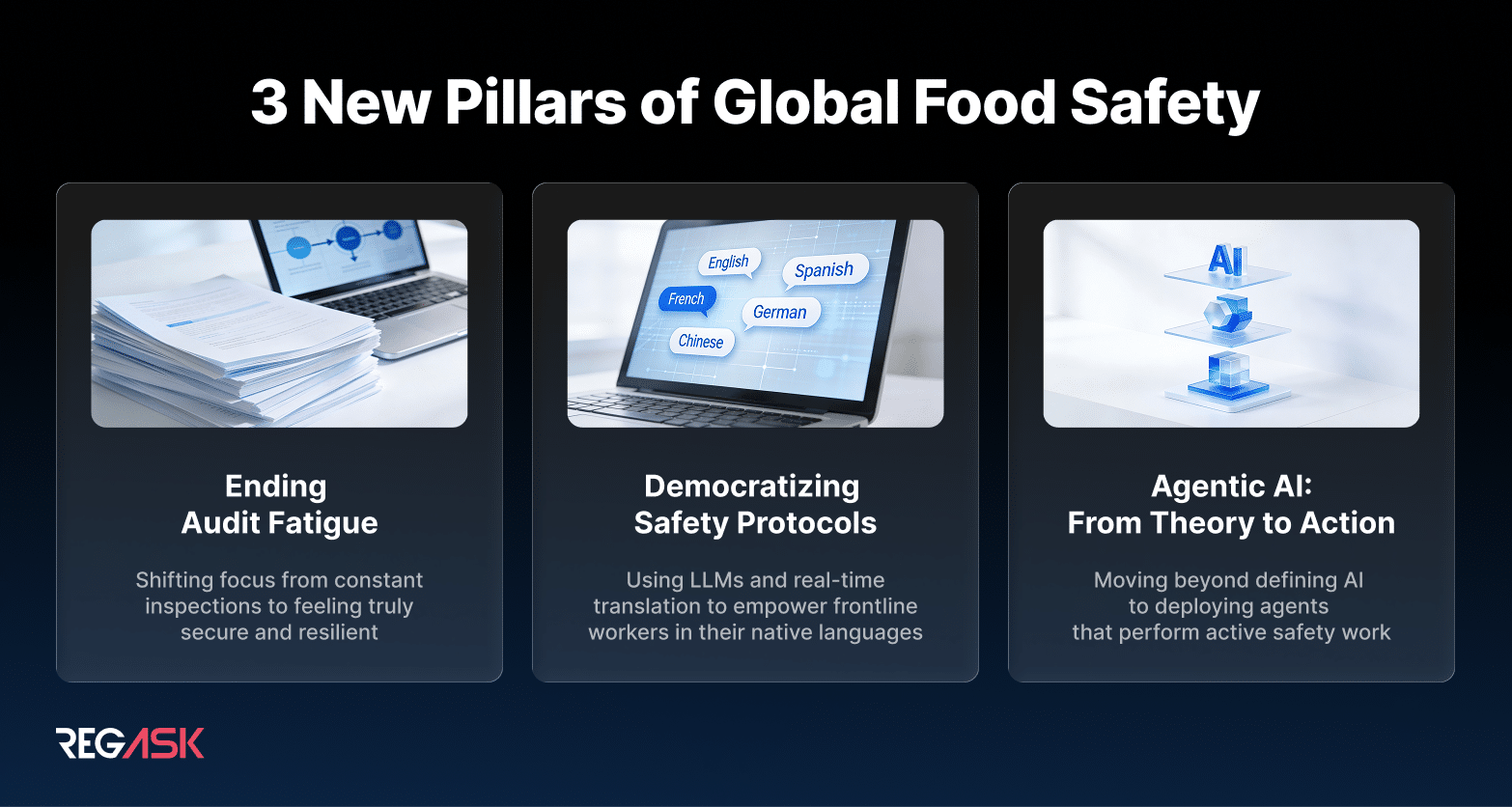
- Audit fatigue and the resilience gap: Organizations are conducting more inspections, yet confidence is not increasing. Meeting audit requirements is no longer the same as being prepared to manage real-world risk.
- Compliance, in every language: LLMs and real-time translation are enabling compliance guidance to reach frontline workers in their native languages, making standards easier to understand and apply on the ground.
- From AI concepts to deployment: The conversation has shifted from “What is AI?” to “How do we deploy agents that can coordinate across fragmented global supply chains?” (the exact challenge RegASK is designed to solve by turning regulatory intelligence into coordinated, cross-market action).
Shia’s Key Observations from the Floor
- Complexity is the new constant: Teams are no longer looking for more information. They are looking for multi-market clarity.
- The shift to orchestration: There is growing demand for platforms that not only monitor change, but also coordinate execution across teams.
- Human-in-the-loop is non-negotiable: AI can accelerate insight and decision-making, but accountability remains with people.
Moving from Fragmentation to Orchestration
Food safety is no longer confined to a single function.
It now spans operations, supply chain, regulatory, and leadership. Growing complexity is also pushing organizations to adopt more connected, digital ways of working.
AI is starting to play a practical role in improving speed and consistency, with human oversight at the center. Alongside this is a stronger focus on end-to-end supply chain resilience, which supports both compliance and long-term performance.
The through-line across all three is clear: the industry doesn’t need more information. It needs orchestration.
The fragmented model, where monitoring, decisions, and execution exist in separate systems, is becoming harder to sustain. Organizations are moving toward more unified approaches that connect these steps, enabling clearer accountability and more consistent execution across markets.
Stay Ahead of the Change
The future of food safety is about having the infrastructure to act when the landscape shifts.
Did you attend GFSI this year? What was your biggest takeaway? Let’s continue the conversation in the comments.
#GFSI2026 #FoodSafety #RegulatoryIntelligence #FoodIndustry #RegASK #SupplyChain